
Acne often settles long before its effects on the skin do, and the marks it leaves can remain visible for years, across a wide range of skin types and ages. Acne scarring is not one condition, though. Scar type, cause, and suitable management vary between individuals, so identifying the scar type is a useful first step.
How Acne Scars Form
Scarring begins with inflammation. When deeper inflammatory lesions disrupt the skin, the body repairs the damaged tissue, and that repair does not always resolve evenly. Too little collagen leaves a depression, while too much leaves a raised scar. Acne severity, delays in effective treatment, skin type, individual predisposition, and picking or squeezing lesions can all influence whether scarring occurs and what form it takes. Early and effective acne management can help reduce that risk.
The Main Types of Acne Scars
Atrophic Scars
Atrophic scars, seen most often, involve a loss of tissue that leaves the skin depressed or indented. They fall into three subtypes:
- Ice Pick Scars: Narrow and deep, extending into the dermis and resembling small puncture marks, and difficult to address because of that depth
- Boxcar Scars: Broader depressions of shallow to medium depth, with defined edges
- Rolling Scars: A wave-like surface caused by fibrous bands tethering the skin to the structures beneath
Hypertrophic and Keloid Scars
Where healing produces excess collagen instead, the result is a raised scar. Hypertrophic scars stay within the boundary of the original lesion, while keloid scars extend past the edges of the wound and may continue to enlarge. Keloids are seen more often in deeper skin tones, and commonly on the chest, shoulders, and back.
Post-Inflammatory Hyperpigmentation
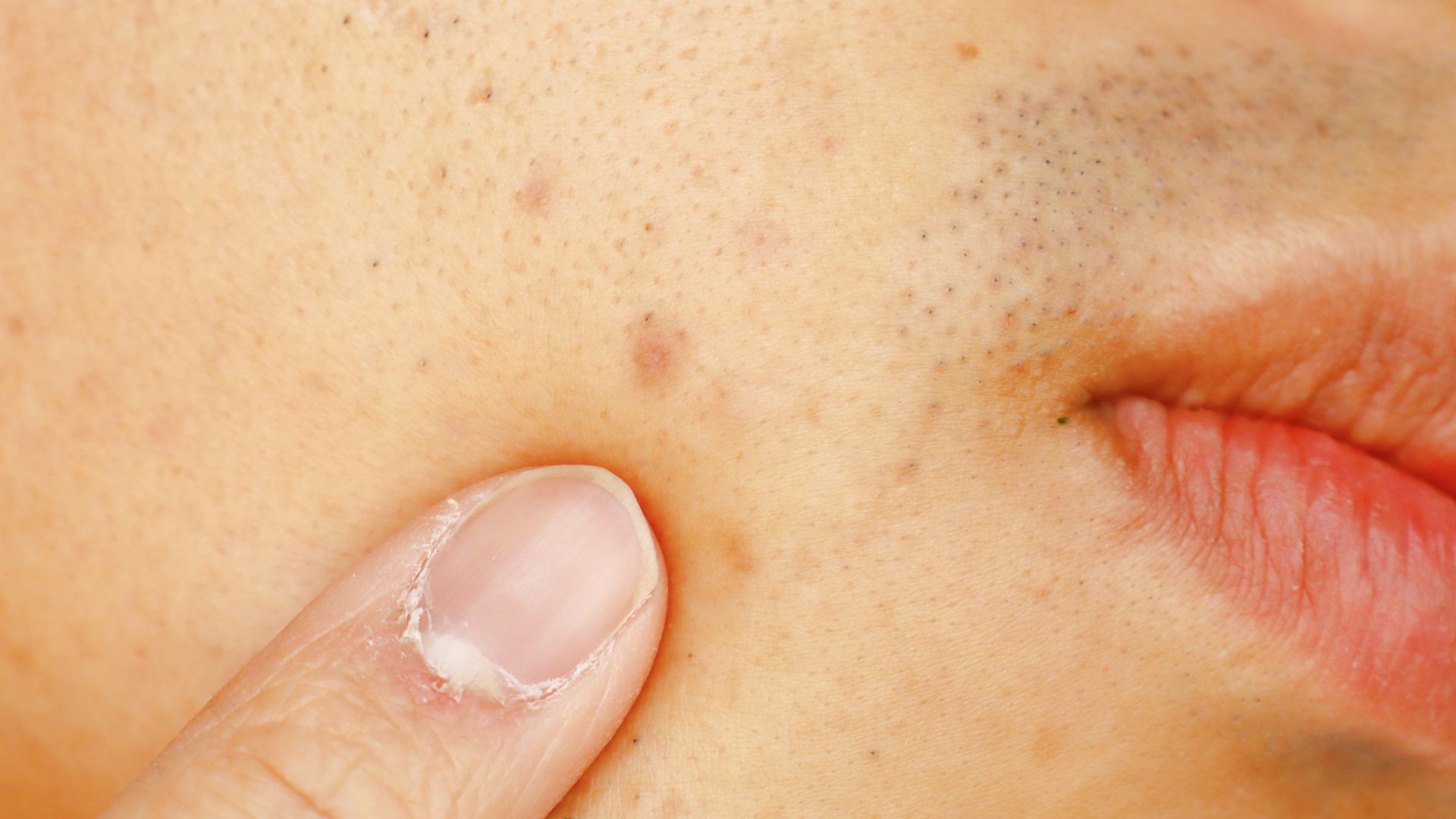
Not every mark left by acne is a scar in the structural sense. Post-inflammatory hyperpigmentation, or PIH, appears as flat darkened patches where a lesion has healed, caused by excess melanin produced in response to inflammation. PIH tends to fade over time, though slowly, and consistent sun protection helps prevent it from darkening further while that happens. Targeted management may help support improvement.
Structural acne scars often do not fully fade on their own, although their appearance may improve with time or treatment. In contrast, pigment marks may fade gradually over months or longer. Sun protection carries particular weight for hyperpigmentation in Singapore, given the high year-round UV exposure here.
Management Considerations by Scar Type
Which approach is appropriate depends on the scar type, its severity, an individual’s skin type, and overall skin health, all assessed by our clinical team during consultation.
- Atrophic Scars: Depending on the scar pattern, skin type and pigmentation risk, approaches may include laser-based treatments, Microneedling RF, TCA Cross, eCO2 Skin Resurfacing Laser, subcision or skin boosters such as Salmon DNA or PDLLA.
- Hypertrophic and Keloid Scars: More involved management, aiming to reduce excess collagen and soften raised tissue
- Post-Inflammatory Hyperpigmentation: Laser-based treatments, or targeted approaches such as fusion laser to address melanin production, alongside sun protection to limit further darkening
In some individuals, more than one scar type is often present at once, so combination approaches are frequently needed for such cases.
The Importance of an Integrated Clinical Approach
Acne scar management requires an integrated clinical approach, since an unsuitable treatment choice can worsen certain scar types or prompt pigmentation changes in susceptible skin. Active acne should be adequately controlled first, as ongoing inflammation can work against treatments and contribute to new scarring. Plans are typically staged, with change building across several sessions, and realistic expectations around that timeline are discussed at consultation.
Addressing Acne Scars at TruGlow
As an acne scar clinic in Singapore, TruGlow Medical Aesthetics begins with an assessment by our clinical team of the scar types present, skin type, and overall skin condition. Any plan that follows draws on the range of non-surgical modalities relevant to that particular presentation, matched to the individual rather than applied as a standard protocol.
Consultations for acne scarring concerns are available at TruGlow, where our clinical team can assess an individual presentation and discuss the management options appropriate to it.
