
Deep within each cheek sits a small, encapsulated pocket of fat called the buccal fat pad. As a distinct fat compartment, it adds fullness to your cheeks and lower face, and if you have ever wondered why that area looks rounder than you expect, its size and prominence may be part of the answer. They are also among the most frequently searched facial contouring concerns in Singapore.
If you are considering buccal fat removal, you may want to understand what is involved before you decide anything. There are surgical and non-surgical approaches to lower-face fullness, though only surgery removes fat from the cheek’s buccal fat pad itself. TruGlow does not offer buccal fat surgery, so the surgical route explained here is for factual, educational purposes only, followed by a closer look at the non-surgical options for lower-face fullness and contour that our clinical team offers.
The two routes differ in recovery, reversibility, and suitability, so knowing both gives you a useful starting point before any consultation. Read on to learn what the buccal fat pad is, how surgical removal works, and what non-surgical options for lower-face fullness and contour involve.
What the Buccal Fat Pad Is and Why It Affects Facial Shape
The buccal fat pad sits between the buccinator muscle, which forms the inner wall of your cheek, and the masseter muscle, which you use for chewing. Anatomical studies describe its extension as a key structure that determines cheek shape, fullness, and contour, and note that it may shrink with age, reducing support for the middle of the cheek.
Your lower face takes its shape from several elements working together, including the buccal fat pad, the masseter muscle, the jaw bone, and the fat just beneath the skin. Fullness here is not always tied to overall body weight, which may be why you can have a rounder lower face even when you are otherwise slim. A naturally larger or more prominent buccal fat pad may contribute to that appearance.
Because bone, muscle, and fat each play a part, the contour you may be hoping for, often described as a V-shaped face, depends on more than one factor.
Surgical Buccal Fat Pad Removal
If you are considering surgical removal of the buccal fat pad, sometimes called bichectomy, it helps to know what it involves. A portion of the fat is taken out through a small incision inside your mouth, and published reviews describe the procedure as usually performed under local anaesthesia, with no incision on the face.
You may also want to know how often problems occur. Reported complication rates are relatively low. In one systematic review, minor complications occurred in fewer than 1 in 10 of the 71 patients assessed. The same review notes that none of the included studies were clinical trials and none evaluated long-term effects such as facial ageing, so the evidence remains limited and the findings should be interpreted with that in mind.
You may also be asking whether the result is permanent. Because the buccal fat pad does not regenerate, removing it is irreversible, which matters because your facial volume naturally declines with age.
A 2021 commentary in a plastic surgery journal noted that how much of the pad persists or diminishes over time remains debated, and raised concern that early or excessive removal may contribute to a hollowed or prematurely aged lower face later in life. The long-term effects of an irreversible change are therefore worth weighing against the desire for a slimmer lower face today.
Recovery after this kind of surgery is usually described in general terms. Some swelling is generally expected in the first few days, and a soft-food diet is commonly advised while the incisions inside your mouth heal. Healing is often said to take around one to two weeks. Timelines vary by individual and surgeon, so you should discuss the details with the surgeon performing the procedure.
Non-Surgical Options for Lower-Face Fullness and Contour: Ultraformer MPT
If you are considering surgery to remove buccal fat, it helps to know that non-surgical options for lower-face fullness and contour also exist. Ultraformer MPT is one of them, used for lower-face fat reduction, slimming, and contouring. It is not a non-surgical version of the surgical procedure. It is a focused ultrasound device, sometimes grouped under the term HIFU (high-intensity focused ultrasound). HIFU does not remove the buccal fat pad, which sits deeper in the cheek than the layers it targets; it works on the fat and tissue closer to the surface of the skin.
Ultraformer MPT works by directing ultrasound energy to converge at specific depths beneath your skin. In the lower face, this produces controlled heat in the targeted layers, aiming to affect the fat cells there, which your body may then clear gradually over time. The same energy may also prompt a collagen response in the deeper skin layers, which aims to support skin firmness while the contour changes.
Results develop progressively rather than immediately, and our clinical team advises on a course of sessions after assessing your face. Compared with surgery, which may change the contour more quickly, the non-surgical route works more gradually. Outcomes vary by individual, and the approach is maintenance-based rather than a one-time fix, so we may discuss periodic sessions to support results over time.
Recovery also looks different. A session generally takes around 30 to 45 minutes, and you may feel mild warmth or slight discomfort while the energy is delivered, which is generally well tolerated. Because the energy passes through the surface of your skin, there is no incision and no surgical wound to heal. You may notice mild redness, swelling, or tingling afterwards, which generally fades with minimal intervention, and downtime is generally described as minimal. Our clinical team provides aftercare advice tailored to you; please let them know if any effects feel severe, unusual, or persistent.
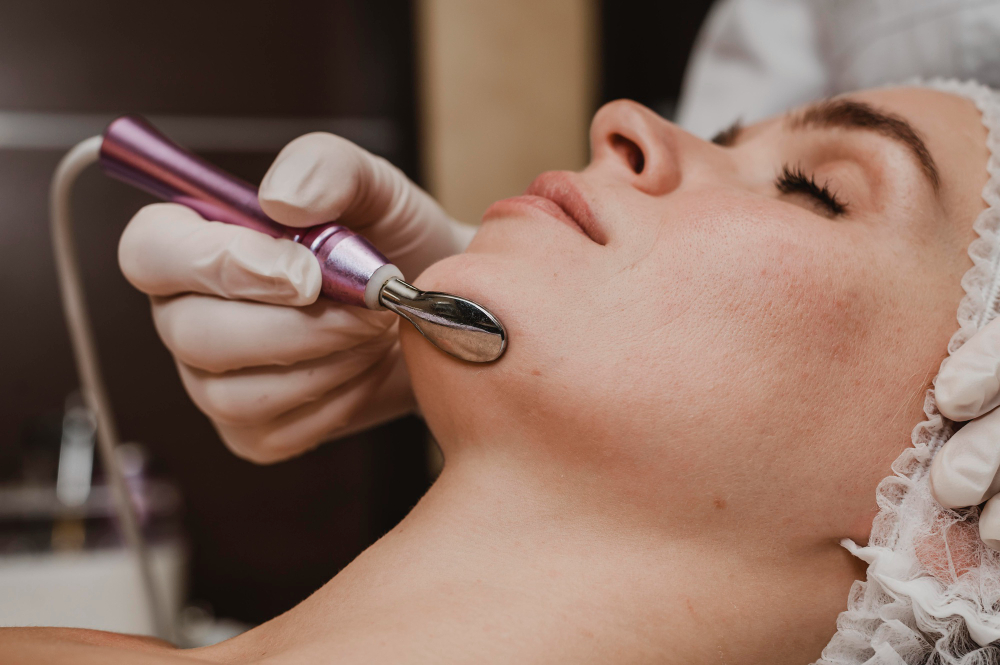
Lower-Face Contouring at TruGlow
At TruGlow, your consultation starts with an assessment. Our clinical team offers Ultraformer MPT for lower-face fat reduction and contouring, and the conversation starts with your goals and a review of your medical history, including any medications or supplements. Before any recommendation is made, the team considers:
- Bone Structure: The shape of your jaw and cheekbones influences how your lower face looks and helps the team understand how much of your fullness comes from fat rather than structure.
- Fat Distribution: Your fullness may sit in the cheeks, beneath the chin, or in both, and each area may call for a different plan.
- Skin Quality: The firmness of your skin affects how your lower face looks as volume changes, which is why skin tightening is considered alongside fat reduction.
Treatment is aimed at fat volume, so if your fullness comes mainly from muscle size or skin laxity, a different plan may be more suitable, and the assessment helps to clarify this. A follow-up appointment may be arranged afterwards to review your progress and discuss whether further sessions may be appropriate.
Fullness beneath the chin is a separate concern from fullness in your cheeks, but the two can be discussed in the same consultation. That includes any interest in a double chin reduction procedure in Singapore, so the plan reflects your whole lower face rather than a single area. The aim is to understand how these elements come together to create a defined jawline and V-shaped face, rather than looking at cheek fat in isolation.
If you are weighing your options for a more contoured lower face, you can book a consultation with our clinical team to understand which approach, if any, may be appropriate for you.
